

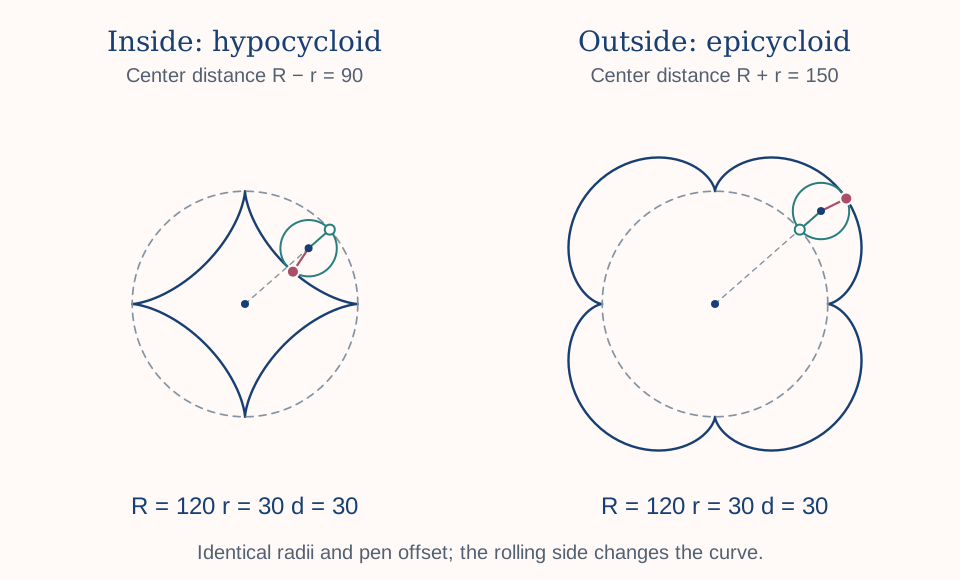
Our imaginary rolling circle can travel along either side of the stationary circle. This seemingly simple distinction gives rise to two fascinating families of curves.
When a smaller circle rolls inside a larger one, its tracing point describes a hypotrochoid. When a circle rolls around the outside of the stationary circle, the result is an epitrochoid.
The names come from Greek: hypo means beneath or under, while epi means upon or on. Both belong to the broader family of curves known as roulettes.
Open the full-size diagram
Two motions in one pair of equations
Despite their sometimes extraordinary appearance, both families have compact mathematical descriptions. We will keep R for the fixed radius, r for the rolling radius, and d for the pen’s distance from the rolling center. The radii are positive; the pen offset may be zero.
One more variable, t, describes the angle through which the rolling circle’s center travels around the stationary circle. As t increases, the equations give successive positions of the pen.
Hypotrochoid — rolling inside
Epitrochoid — rolling outside
In each pair, the first term describes the circular journey of the rolling circle’s center. The second describes the pen’s motion around that center. Combining them produces the finished curve.
For the ordinary inside arrangement, the centers are separated by R − r; for the outside arrangement, by R + r. The no-slip condition determines the corresponding rotation of the pen. The signs above also fix its starting orientation, matching the conventions used by PRIV.
A pen with a mind of its own
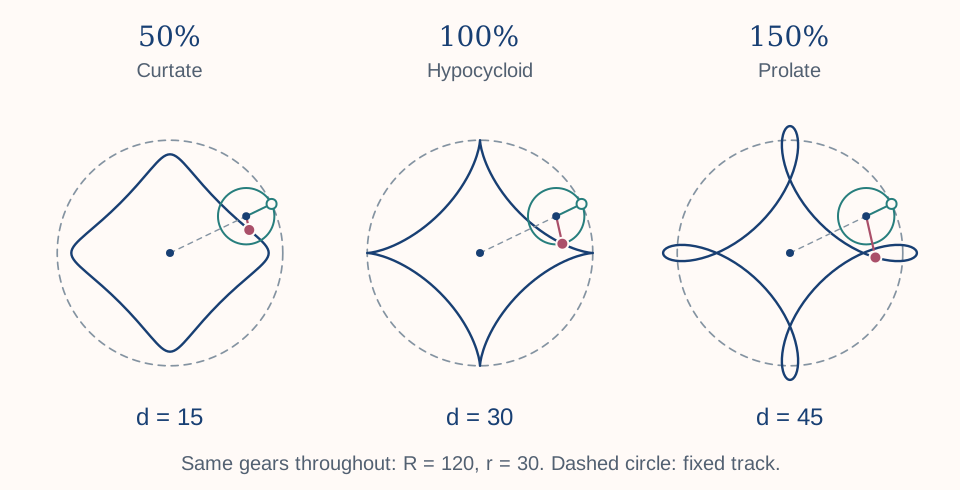
Moving the pen introduces another family of variations, without changing the equations:
- d = 0: the pen sits at the rolling center and traces a circle. The exception is the collapsed inside arrangement with equal radii, where it remains at a point.
- 0 < d < r: the pen is inside the rolling circumference. These are curtate trochoids, with rounded rather than cusped features.
- d = r: the pen lies on the circumference. These special curves are called hypocycloids and epicycloids, and normally have sharp mathematical cusps. A few degenerate configurations need separate treatment.
- d > r: the pen extends beyond the circumference. These prolate trochoids can develop overlapping loops.
Open the full-size diagram
“Prolate” describes the pen position, not a promise that every ratio produces loops. For example, an inside arrangement with R = 2r traces an ellipse when d differs from r, and a line segment when they are equal. We will meet those special cases shortly.
Try these pen positions in the PRIV Playground. Its pen offset is a percentage of the rolling radius: 100% places the pen on the circumference, and 150% carries it halfway beyond it.
The patterns may contain dozens of petals, crossings, or cusps, yet they remain governed by a handful of numbers and two related motions. With all that turning and looping, how does the pen ever find its way back to where it started?