

Imagine a circle rolling along the edge of another circle, carrying an imaginary pen along for the ride. As the circle moves and turns, the pen traces a continuous path. That path is called a roulette, and it is the beginning of some surprisingly extraordinary geometry.
More generally, a roulette is a curve traced by a point attached to one shape as it rolls along another. Circles give us a particularly inviting place to start.
The pen does not have to sit on the rolling circle’s circumference. It can be anywhere relative to its center, and changing that position can dramatically alter the resulting pattern.
Three measurements, a remarkable range of possibilities
- R — Fixed radius
- The radius of the stationary circle.
- r — Rolling radius
- The radius of the circle traveling along it.
- d — Pen offset
- The distance from the rolling circle’s center to the tracing point.
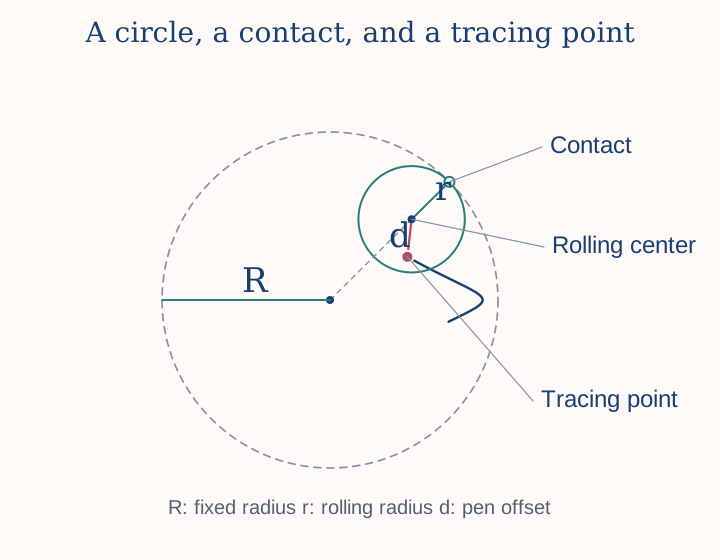
Open the full-size diagram
When we use gears, their tooth counts provide a convenient substitute for radii. Gears with equally spaced, compatible teeth have pitch radii proportional to their tooth counts. We can therefore explore a design using gear counts, then scale the finished vector to suit a piece of stock.
The rule that connects it all
There is one essential condition: the rolling circle must move without slipping. The distance traveled along the contact surfaces determines how much the rolling circle turns.
Once we know our three measurements and which side of the stationary circle the rolling circle follows, we can calculate the pen’s position throughout its journey. The patterns may look intricate, but the construction is wonderfully compact.
And that is where the fun begins.