
The mechanical drawing toys many of us remember from childhood were ingenious little devices. A handful of plastic gears, a pen, and a reasonably steady hand could produce surprisingly elaborate patterns.
Their physical construction imposed limits. A pen needed a hole to sit in, a gear had to fit its ring, and the available tooth counts constrained the relationships between the two.
Mathematics has no plastic teeth to collide and no holes to drill. Replacing the mechanism with its equations opens some fascinating possibilities.
The perfectly pointed cusp
Move the pen outward until its distance from the rolling center equals the rolling radius:
At the contact point, the tracing point momentarily stops. In a nondegenerate hypocycloid or epicycloid, it then moves away through a sharp mathematical cusp. The two branches meet at a common tangent line, with the direction of travel reversing through the tip.
An ordinary drawing gear cannot provide a pen hole exactly at its working circumference, where the teeth and contact are. Our imaginary pen has no such restriction. A vector can represent that tip very precisely, although the sharpness of a physical engraving still depends on the cutter or laser.
There are exceptions to the usual cusp picture. With inside rolling, R = 2r and d = r produce a straight segment traced back and forth, rather than a two-branched pointed ornament. With R = r, the path collapses altogether. These are degenerate cases, not failures of the equations.
When the pen escapes the gear
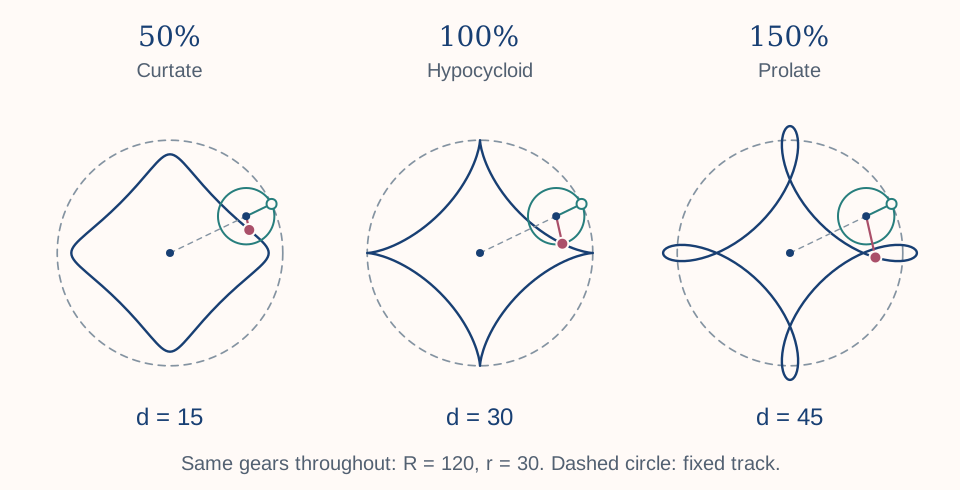
Nothing in the equations requires the pen to remain within the rolling circumference. Move it beyond the edge and we obtain a prolate trochoid:
These extended constructions can form overlapping loops and elaborate intersections. A hypotrochoid can even reach outside its stationary circle.
Open the full-size diagram
Take a fixed radius of 120 and a rolling radius of 30. At 150% offset, the pen is 45 units from the rolling center. Its greatest distance from the stationary center is:
The pen reaches 15 units beyond the fixed circle’s radius. We have not changed the equations; we have allowed the pen to occupy a position a conventional drawing toy cannot provide. A specially built mechanical arm could do something similar, but no extra hardware is required here.
Try 120/30 in the PRIV Playground and move the pen from 50% through 100% to 150%. Watch how the loops emerge as it crosses the circumference.
A gear that will not fit
Now challenge a more fundamental assumption. What if the rolling circle is larger than the stationary circle?
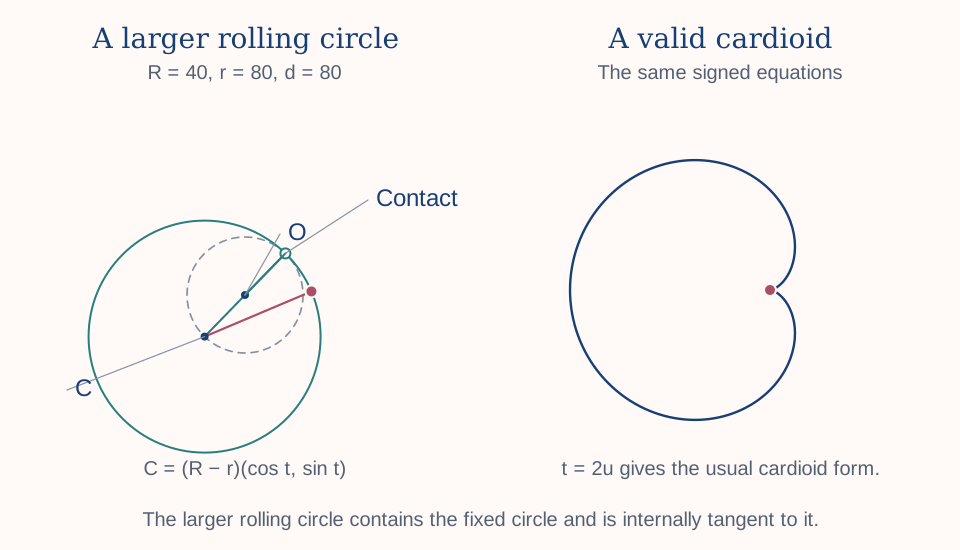
The familiar small-gear-inside-a-ring arrangement is impossible, but the hypotrochoid equations remain meaningful. The larger rolling circle now encloses the smaller fixed circle, touching it internally.
The coefficient R − r is negative. This is a signed coordinate coefficient, not a negative physical distance: it places the rolling center on the opposite side of the chosen radial direction. The actual separation of the centers is |R − r|.
Here is a particularly delightful example:
Open the full-size diagram
The result is a cardioid, a heart-shaped curve with one cusp. Substituting these values into the inside equations and writing t = 2u gives:
The rolling center makes two orbits while the cardioid is traced once. The equations have not failed; our original mental picture was too restrictive. This particular study is outside the Playground’s gear ranges, so the illustration supplies the experiment.
And the gear that goes nowhere
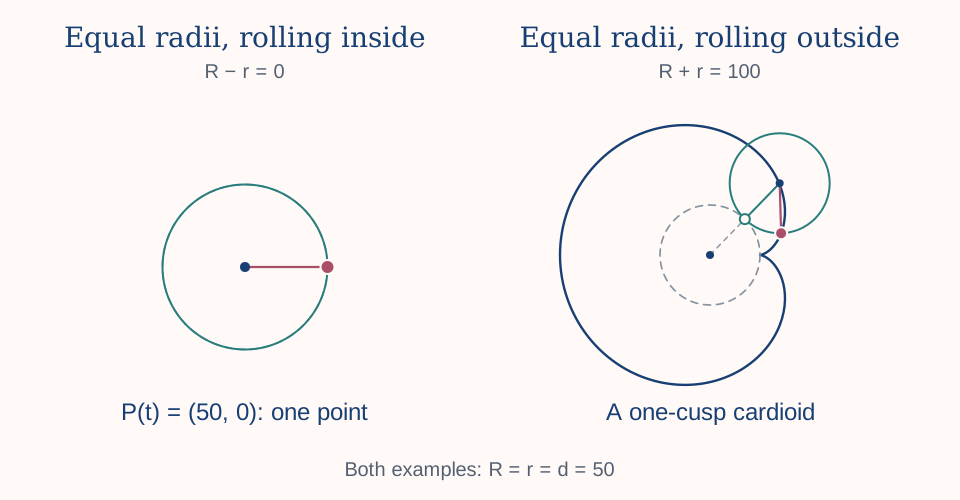
There is a boundary between the two internally tangent arrangements. Set R = r, and both R − r and its rotation ratio become zero. The inside equations reduce to a single unmoving point:
Open the full-size diagram
PRIV treats the collapsed inside configuration as unsuitable for generating a vector. Equal radii with outside rolling are entirely valid: the center separation is R + r, and a pen on the circumference produces another cardioid.
The freedom of mathematical construction
A physical mechanism is one way to produce a mathematical relationship, but it does not define that relationship’s limits. We can place the pen precisely on a circumference, carry it beyond an imaginary gear, or explore an internally tangent arrangement no ordinary drawing toy offers.
That freedom becomes more useful still when we give the gear a different track to follow. If circles can offer this much variety, what might happen when we replace them with the outline of a picture frame?