

Look closely at an intricate hypotrochoid. The curve may cross itself hundreds of times, weave through dozens of lobes, and appear to wander endlessly around the drawing. Yet with the integer gear counts used by PRIV, the pen eventually returns to its starting configuration, ready to trace precisely the same path again.
This is not luck, or a matter of drawing the final point close enough to the first. The rational relationship between the gear sizes guarantees a complete repeating motion.
Two motions, one destination
Our tracing point participates in two simultaneous motions. The rolling circle’s center travels around the stationary circle while the pen rotates around the rolling center.
After one journey around the stationary circle, the pen may not have returned to its original orientation. Drawing must continue until the center’s position and the pen’s orientation repeat together.
Think of two clock hands moving at different speeds. They point in different directions for most of their journey, but when their speeds have a rational relationship, their original arrangement eventually repeats. For circular roulettes, the ratio of the two radii provides that relationship.
Why integer gear sizes matter
Positive integer tooth counts give us a rational ratio automatically: one whole number divided by another. Compatible gears have radii in the same proportion, so the two circular motions have a common period.
To find it, we use the greatest common divisor, or GCD: the largest integer that divides both counts without a remainder. Write the radii in these common gear-count units, and call their GCD g.
For the general, nondegenerate hypotrochoid or epitrochoid, the two useful counts are:
Orbits counts the rolling center’s complete journeys around the stationary circle. Lobes describes the pattern’s repeating features around its center; their appearance depends on the pen offset, and they need not look like separate petals. The count becomes less useful for special cases such as an ordinary circle or a retraced line.
A real example: 141 and 45
Set the outer gear to 141, the inner gear to 45, and the pen offset to 30%. The GCD is 3, so the ratio reduces to 47/15.
The finished pattern has 47 lobes, traced over 15 orbits. The rolling center must travel around the stationary circle fifteen times before the complete motion repeats.
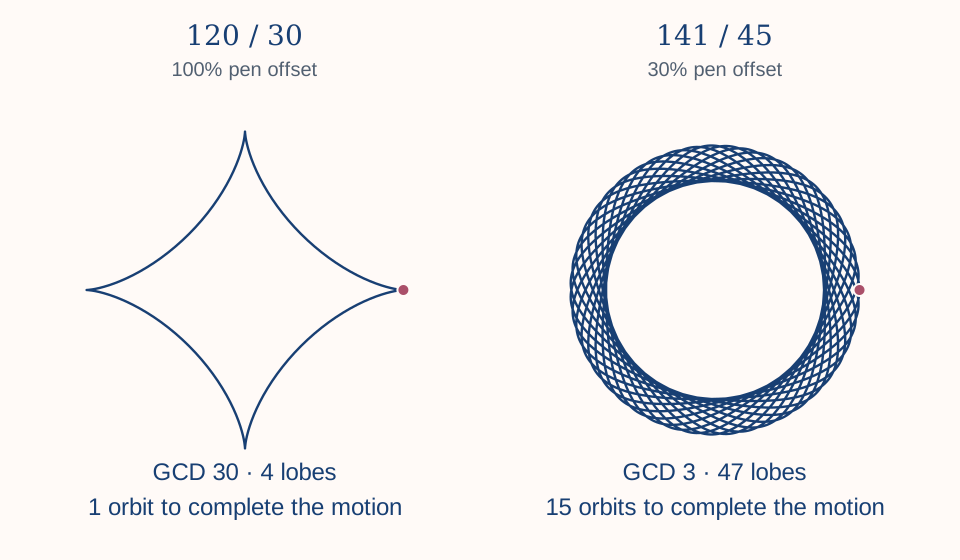
Open the full-size diagram
What looks like an elaborate woven ornament is the result of two simple motions following an exact relationship. The 141/45 design can be reproduced in the PRIV Playground using the same three settings.
How much turning makes one complete pattern?
The parameter t measures an angle, so one orbit corresponds to an increase of 2π radians. For positive integer gear-count radii, a complete period is:
For 141/45, this gives:
T is an interval of the angular parameter, not a duration in seconds. The same formula works for both inside and outside rolling. Adding or subtracting one full turn in the relative rotation does not change the denominator of the reduced gear ratio.
The pen offset changes the appearance without changing the two rotational frequencies. We can move the pen inward, onto the circumference, or beyond it without losing closure. A special case can repeat sooner: when d = 0, only the rolling center’s circle is drawn, so one orbit is enough. Equal radii in the inside equations collapse the entire path to a point.
Do the radii have to be integers?
No. Any rational ratio allows the motions to synchronize. Integer gear counts are simply a convenient way of ensuring it.
With an irrational ratio, a general two-motion roulette has no exact repeating period. That does not mean the pen can never revisit a point or cross an earlier part of the drawing; it means the complete motion never returns to its starting configuration. The centered-pen circle is again an exception because its visible trace no longer depends on both motions.
And a closed curve is not necessarily a simple curve. It may cross itself, form loops, or retrace part of its path. Closure tells us that the full motion repeats, not that the pen avoids every point it has already visited.
Integer parameters make circular ornaments wonderfully predictable. Replacing the circle with straight sides, rounded corners, or an oval will make finding our way home a more interesting problem. First, though, there are a few possibilities hiding beyond the limits of our imaginary plastic gears.